Goga Trascierra
Baja Vibes
Price by request
Artwork Description
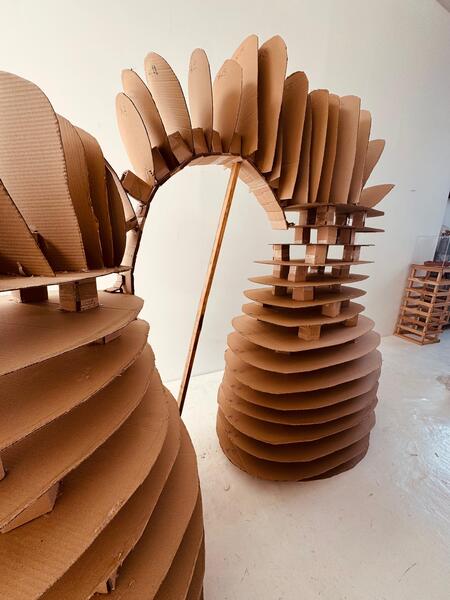
It is called Baja Vibes and takes the form of an arch. Not one built from regular blocks, but something closer to the arches that appear in nature, those that wind and time eventually carve into rock. Here, however, the process is reversed: what we see is not erosion but accumulation. The piece, conceived for La Paz, Baja California Sur, and placed next to a reflecting pool in a hotel patio, immediately activates several associations: entrance arch, triumphal arch, natural formation, mineral remainder, a structure that receives and at the same time imposes a form of passage. Its scale (three meters high) gives it a strong presence, though not monumental in the sense of something closed or authoritarian. There is something more vulnerable about it, more unstable, as if it were still in the process of being made, or unmade, in front of us. The structure is a framework of thin steel rods coated with brick dust. This detail is not minor: the skeleton and the surface share the same tone, as if the piece wished to erase the difference between support and skin. Onto this mesh adhere hundreds of small bricks made specifically for the work, too fragile or too specific to belong to the order of functional construction. We are not dealing with the brick as a useful module, but with the brick displaced toward another logic: one closer to crust, to sediment, to the formation of a surface that advances by accumulation. They simply occupy space, adhering, multiplying. And they do so unevenly: at the base the volume is dense, almost compact; as the gaze rises, the bricks become scarce. The mass loses weight. Some seem to advance toward the crest; others remain halfway. Each follows its own rhythm, ascending is no guarantee. Only a few reach the top; the reasons hardly matter. It can also be read the other way around. Not as bricks climbing upward, but as a layer gradually covering (or uncovering?) the structure. A skin slowly forming, concealing the skeleton. What we see would then be a suspended moment in that process: the matter taking possession of the support, covering it without ever fully completing the task. Or perhaps the support slipping free from that layer, undressing itself, removing its masks. Within this dialogue between steel, binder, and brick an important tension emerges. There is hardness, weight, resistance, but also dust, adhesion, fragility. Steel belongs to the realm of engineering, of the precise line, of calculated tension. Brick, by contrast, refers to the land, the modular, the patient labor of construction. Between them appears a third element: the binder that allows the mass to hold together. None fully dominates. Nor is there symmetry or geometric perfection here. The form tilts, it distorts itself, responding more to an organic logic than an architectural one. And the ochre tones ultimately anchor it to the landscape, as if the structure had emerged from the earth and remained there, paused.
Identification attributes
Physical attributes